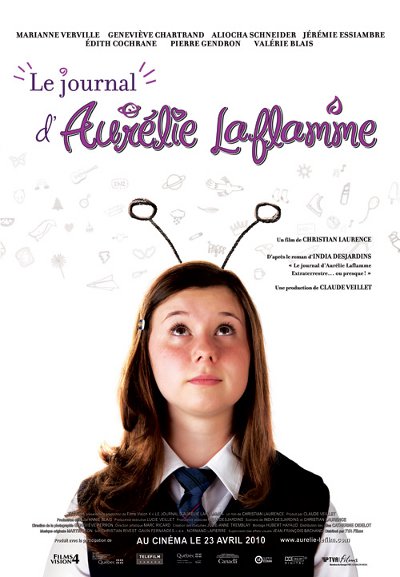
Journal d’Aurélie Laflamme, Le – Film de Christian Laurence

Le Journal d’Aurélie Laflamme est une comédie pour adolescents dont le personnage principal est tiré de la populaire série de livres écrits par l’auteure India Desjardins.

Le journal d’Aurélie Laflamme de Christian Laurence

Le journal d’Aurélie Laflamme de Christian Laurence

Le Journal d’Aurélie Laflamme est une comédie pour adolescents dont le personnage principal est tiré de la populaire série de livres écrits par l’auteure India Desjardins. Ce film est basé sur le premier tome de la série « Aurélie Laflamme, Extraterrestre ou presque ». Le réalisateur Christian Laurence vient du domaine de la télévision et signe ici son premier long-métrage de cinéma.

Comme on pouvait s’en douter d’après les succès obtenus par les livres, Le Journal d’Aurélie Laflamme fut reçu chaleureusement par le jeune public québécois qui en fit l’un des succès au box office de 2010. Au niveau international, le film de Christian Laurence eut droit à quelques sélections dans les festivals francophones, sans toutefois se démarquer outre mesure.

Un second film tiré des aventures d’Aurélie Laflamme a été produit par la suite.

Résumé

Aurélie est une adolescente de 14 ans, un peu perdue et donc en quête de solutions. Entre les habitudes de sa mère sédentaire et les chicanes avec sa meilleure amie, elle rêve à son premier french kiss ! Mais au fond, Aurélie se sent bien seule dans l'’univers, surtout depuis la mort de son père, il ya 5 ans.

Et si son père était simplement un extraterrestre, ayant quitté la Terre pour rejoindre sa planète? Génétique oblige, Aurélie serait elle-même une extraterrestre! Ceci expliquerait bien des choses. Par exemple, pourquoi elle se sent si différente des autres (surtout de sa mère), pourquoi elle n'’est pas capable d’'enligner deux mots sans faire une gaffe, et surtout pourquoi les garçons lui tapent vraiment sur les nerfs.

Synopsis officiel

Distribution

Marianne Verville (Aurélie Laflamme) ; Geneviève Chartrand (Kat) ; Aliocha Schneider (Nicolas) ; Jérémie Essiambre (Truch) ; Edith Cochrane (mère d’Aurélie) ; Pierre Gendron (Denis Beaulieu) ; Valérie Blais (Marie-Claude) ; Sylvie Potvin (Soeur Rose)

Fiche technique

Genre: Comédie dramatique - Origine: Québec, 2009 - Sortie en salles: 23 avril 2010 dans 83 salles au Québec - Durée: 1h48 - Classement: Général - Tournage: septembre-octobre 2009 - Budget approximatif: 4,1 M$

Réalisation : Christian Laurence - Scénario : Christian Laurence et India Desjardins, d'après le roman éponyme d'India Desjardins - Production : Claude Veillet et Lucie Veillet - Société de production : Films Vision 4 - Distribution : TVA Films

Équipe technique - Costumes : Julie-Anne Tremblay - Direction artistique : Marc Ricard - Montage : Hubert Hayaud - Musique : Martin Léon - Photographie : Geneviève Perron
Laura Dern, as she approaches her 60th birthday, has issued a rallying cry to a youth-obsessed industry. She suggests that Western cinema should look to European traditions for inspiration, noting that French and Italian cinema have long found beauty and sensuality in older performers, while Hollywood remains stuck in a cycle of erasure. Dern argues that the industry frequently ignores the universal realities of growing older: "While cinema is saturated with coming-of-age tales, it rarely explores the complexities of later life, including the search for community and the navigation of mortality".

Moreover, there is a lingering "genre gap." Mature women are now allowed to lead dramas and dark comedies, but they are still largely excluded from big-budget action franchises (Michelle Yeoh being the glorious exception) and studio romantic comedies. When will we see a 58-year-old woman as the lead in a John Wick style revenge flick that is not played for "granny humor"? When will we see a genuine rom-com where both leads have AARP cards?

Hollywood's embrace of older female talent is not merely a moral triumph; it is a savvy financial calculation. The global population is aging, and women over 40 represent a massive, affluent consumer demographic with significant purchasing power and a desire to see their lives reflected accurately on screen.

What older women do appear on screen are often relegated to supporting roles or portrayed as grumpy, frumpy or senile. As Dr Carole Easton OBE, chief executive of the Centre for Ageing Better, noted: “The representation of older actors in major film roles is so disproportionate to the proportion of older women in the cinema-going audience, the lack of representation is insulting frankly”.

These women, along with many others, have paved the way for future generations of mature women in entertainment and cinema, breaking down barriers and challenging traditional norms. Their contributions have enriched the industry, promoting a more inclusive and diverse representation of women on screen.

The rise of platforms like Netflix, HBO, Hulu, and Apple TV+ disrupted traditional cinematic structures. Unlike standard theatrical releases that rely heavily on explosive, youth-oriented spectacles, streaming platforms thrive on character-driven, episodic storytelling. This format requires complex emotional arcs, providing fertile ground for mature actresses to showcase their depth. Shows like Grace and Frankie (starring Jane Fonda and Lily Tomlin) and Big Little Lies (featuring Nicole Kidman, Reese Witherspoon, and Laura Dern) proved that audiences crave stories rooted in adult lived experiences. The Power of the Female Purse

Modern cinema and television offer several recurring ways mature women are currently represented: Power and Authority : Characters like Meryl Streep’s Miranda Priestly in The Devil Wears Prada

The landscape of entertainment is undergoing a seismic shift. For decades, the "ingenue" was the industry standard, while women over 40 were often relegated to supporting roles as mothers or weary crones. Today, mature women are not just staying in the frame—they are commanding it.