We use cookies to help give you the best possible browsing experience. Using our site implies your consent, click here to read more.
Don't show again


* No subscription
"I really do believe you guys have cracked the code - I am truly terrible at languages, but your system sticks in my brain, it must be magic!"
Row Turner, The British Forces Broadcasting Service


The fundamental purpose of a security camera is to record video. Yet, the data these devices collect is incredibly sensitive. A camera captures when you wake up, when you leave your house, who visits you, and what you do in your yard.
Home security camera systems can raise several privacy concerns, including:
Certain tech companies comply with law enforcement requests by sharing camera footage without a warrant or user consent during emergencies. This bypasses traditional legal protections and dilutes your control over your own data. Architectural Choices: Cloud vs. Local Storage
By combining strong cybersecurity hygiene with a basic respect for the reasonable expectations of others, you can achieve the ultimate goal:
The regulatory framework for home security camera systems varies by jurisdiction, but several countries have implemented laws and regulations to protect individual privacy, including:
You know the 'earworm' effect, catchy music and lyrics that you can't get out of your head?
Using the phenomenal power of music, the Earworms Method plants the words of a foreign language into the auditory cortex of your brain - ready for instant recall.
Using music as the medium is not only fun and entertaining, it is also highly effective.
Firstly, music primes the neural networks and puts the learner into the optimum state of consciousness for learning, the so-called Alpha state; relaxed but at the same time receptive.
Secondly, music engages and stimulates both right and left hemispheres of the brain, unleashing more learning potential. Music also allows for repetition without monotony.
All these features together lead to a much higher rate of retention than with traditional learning methods.
Instead of seeing a language in terms of individual words and grammar, the Earworms approach immerses the learner in real-life dialogues and expressions.
These are then broken down into smaller bite-size chunks, practiced rhythmically with music and then reconstructed into full sentences.
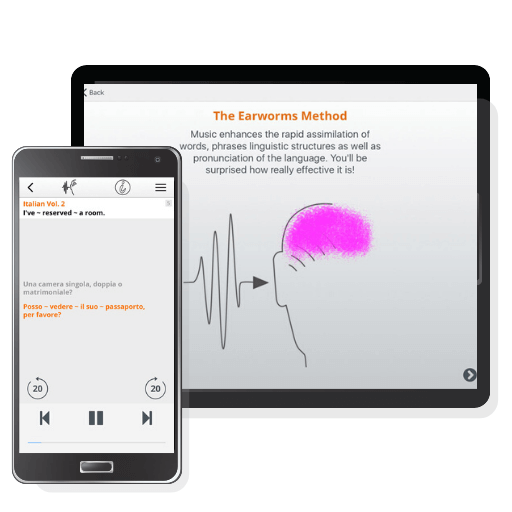
The Earworms App now features a karaoke-like synchronised text function, which gives an extra bit of visual input to reinforce the audio learning effect. It also includes a downloadable PDF transcript of the course.
"Brilliant! Should be a famous learning technique." - Molar
"I love this programme, and find I'm remembering words and phrases effortlessly. Brilliant product." - Churchpolly
The fundamental purpose of a security camera is to record video. Yet, the data these devices collect is incredibly sensitive. A camera captures when you wake up, when you leave your house, who visits you, and what you do in your yard.
Home security camera systems can raise several privacy concerns, including: The fundamental purpose of a security camera is
Certain tech companies comply with law enforcement requests by sharing camera footage without a warrant or user consent during emergencies. This bypasses traditional legal protections and dilutes your control over your own data. Architectural Choices: Cloud vs. Local Storage Home security camera systems can raise several privacy
By combining strong cybersecurity hygiene with a basic respect for the reasonable expectations of others, you can achieve the ultimate goal: Local Storage By combining strong cybersecurity hygiene with
The regulatory framework for home security camera systems varies by jurisdiction, but several countries have implemented laws and regulations to protect individual privacy, including: